Communicating Life-Cycle Design Through Visual Translation: An LCA-Based Alternative Narrative for Takeaway Beverage Cups
Keywords:
life-cycle assessment (LCA), circular economy, Sustainable Design, visual translation, behavior changeAbstract
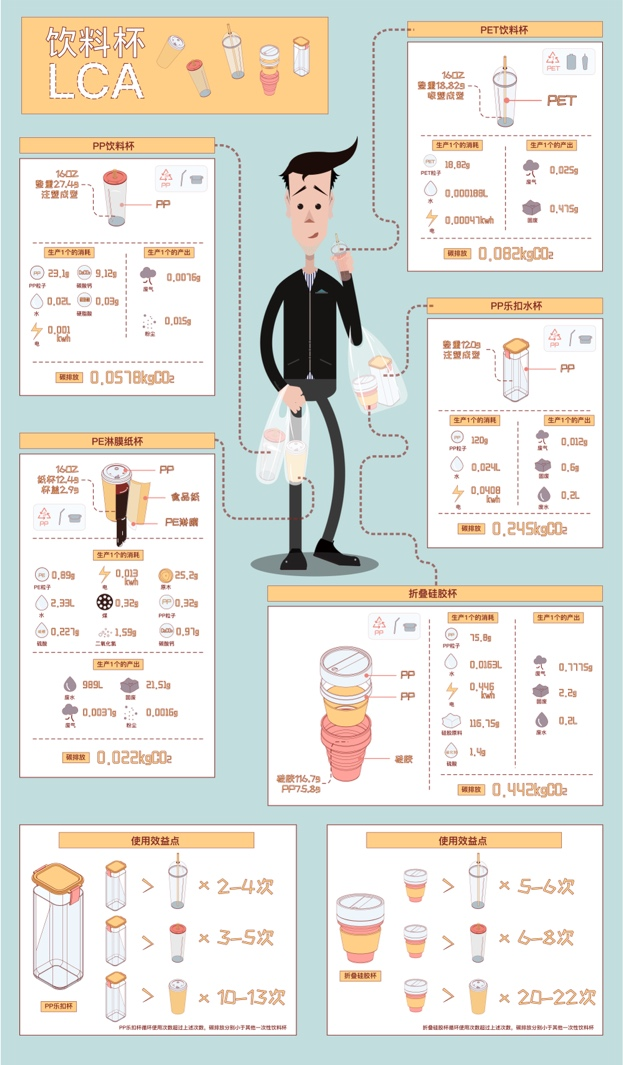
Under the agendas of carbon neutrality and the circular economy, life-cycle assessment (LCA) can inform low-carbon decisions, yet its complexity and dependence on system boundaries often hinder public understanding and actionable guidance. This study develops an alternative narrative that translates LCA evidence into poster-readable information for everyday substitution decisions, using takeaway beverage cups as a representative high-frequency consumption system. Using GaBi, we traced and modeled the life cycles of mainstream single-use cup systems from major coffee and milk-tea shops around the Tsinghua Science Park and compared their carbon emissions with two reusable alternatives. The results identify break-even thresholds of use frequency: beyond these points, reusable cups offset the cumulative emissions of single-use baselines and deliver sustained mitigation benefits with continued reuse. Building on the threshold evidence, we propose a poster-based visual translation framework that reorganizes LCA outputs into a modular information architecture—combining unit-explicit footprints, process-chain scaffolds, and a threshold layer—to support comparability, traceability, and actionability in low-attention consumption contexts. The study offers a replicable approach for communicating life-cycle evidence through visual translation and for framing “reuse” as an operational, condition-specific decision rule rather than a generic moral appeal.