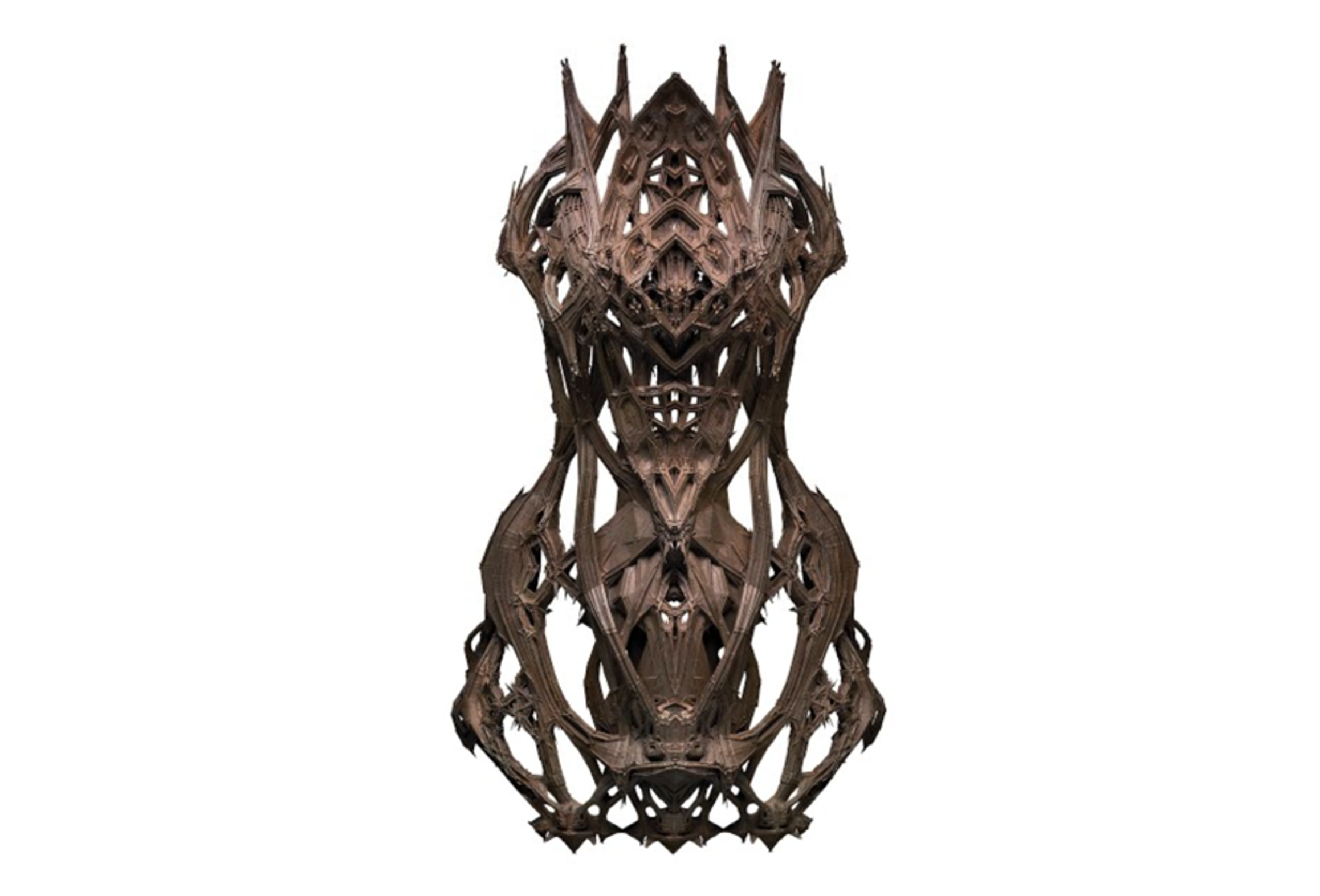
Sculptural Ornament in the Technological Age: Transcultural Geometries, Material Intelligence, and the New Life of Motifs
Keywords:
Ornament; Sculpturality; Generative Geometry; Material IntelligenceAbstract
This article examines the contemporary reinvention of ornament at the intersection of fashion, jewelry, and sculpture, arguing that traditional motifs have re-emerged not through decorative revival but through a fundamental shift in their ontological status. Digital computation, additive manufacturing, and AI-driven pattern analysis reveal the latent geometries—continuity, recursion, porosity, curvature flow— that historically structured ornamental systems across civilizations. Once bound to specific materials and cosmologies, motifs such as the cloud-scroll, arabesque, boteh, quatrefoil, and lotus rosette now operate as generative spatial behaviors capable of producing form, organizing structure, and mediating material performance. Through close analysis of design practices ranging from Iris van Herpen’s wearable architectures to the micro-architectural precision of Boucheron, Cartier, Van Cleef & Arpels, and Chinese heritage jewelers, the study demonstrates that ornament is becoming a trans-scalar and transcultural morphology. Sculpture serves as the conceptual mediator that makes these transformations legible, revealing that motifs migrate across cultures through structural affinity rather than iconographic imitation. The article proposes a sculptural theory of ornament in which motifs function as living geometries—agents of cultural memory and engines of formal innovation within the technologically mediated design landscape.