Study on the Typological Evolution of Traditional Jiangnan Water Settlements Based on Ecological Adaptation: A Comparative Analysis of Lowland and Upland Villages
Keywords:
lowland settlements; upland settlements, ecological adaptability; human settlement space; evolutionary processAbstract
Driven by rapid urbanization, traditional rural settlements in the Jiangnan region are shifting from a naturally growing, organic pattern to a standardized, mechanized layout, posing a risk of disappearing their unique waterside ecological and cultural landscapes. To understand the formation logic and ecological adaptability of traditional waterside settlements, this study systematically analyzes the natural environment, living space, and ecological characteristics of two typical types of settlements in Jiangnan: lowland and upland areas.
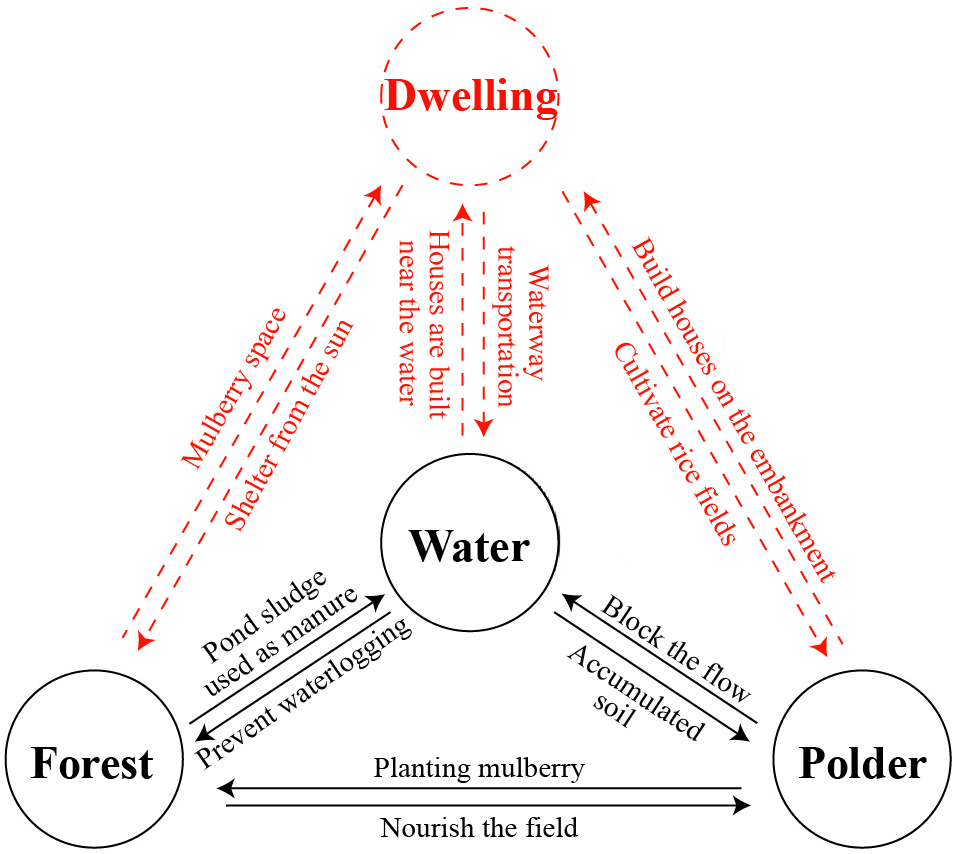
It focuses on how the elements of "water, fields, and forests" and their ecological relationships shape the spatial form of traditional waterside towns. The study indicates that low-lying areas are characterized by numerous lakes and a well-developed water network, forming a settlement pattern of riverside growth and interdependent rice-mulberry-dike systems, fostering typical ecological wisdom such as the "pond-mulberry-silkworm-fish" cycle system. In contrast, high-lying settlements, affected by tides and lacking freshwater, rely on tail-shaped water storage channels and cotton fields to construct an ecological geomorphological feature of "cotton planting in cotton ditches, soybean planting in silt, and rice-cotton rotation," with residences expanding centrally around artificial water systems.
The study further categorized settlement types in two regions: low-lying settlements exhibited four water-dependent patterns ("I", "L", "Y", and "U"), while high-lying settlements displayed drought-adaptive forms such as "clustered," "scattered," "patchy," and "fragmented" types, revealing a deep interaction between hydrological environment, human settlement space, and settlement development patterns. The research indicates that the spatial morphology and ecological strategies of traditional Jiangnan water towns are ecological wisdom evolved over a long period under specific natural conditions, production methods, and cultural traditions. A systematic analysis of these settlements provides important reference for understanding the ecological adaptation mechanisms and cultural roots of Jiangnan water towns, and also offers theoretical basis and practical insights for water town protection, settlement revitalization, and beautiful village construction in the context of current rural revitalization. Future research on Jiangnan water towns needs to be further developed from multiple dimensions, including historical inheritance, cultural heritage protection, and the continuation of ecological wisdom, to promote the sustainable development of traditional human settlements.