AI-Driven Design Research Based on the Visual Lexicon of Han Dynasty Stone Relief
Keywords:
Han Dynasty stone reliefs, traditional patterns, AI-generated content (AIGC), LoRA technology, visual symbols, modern translationAbstract
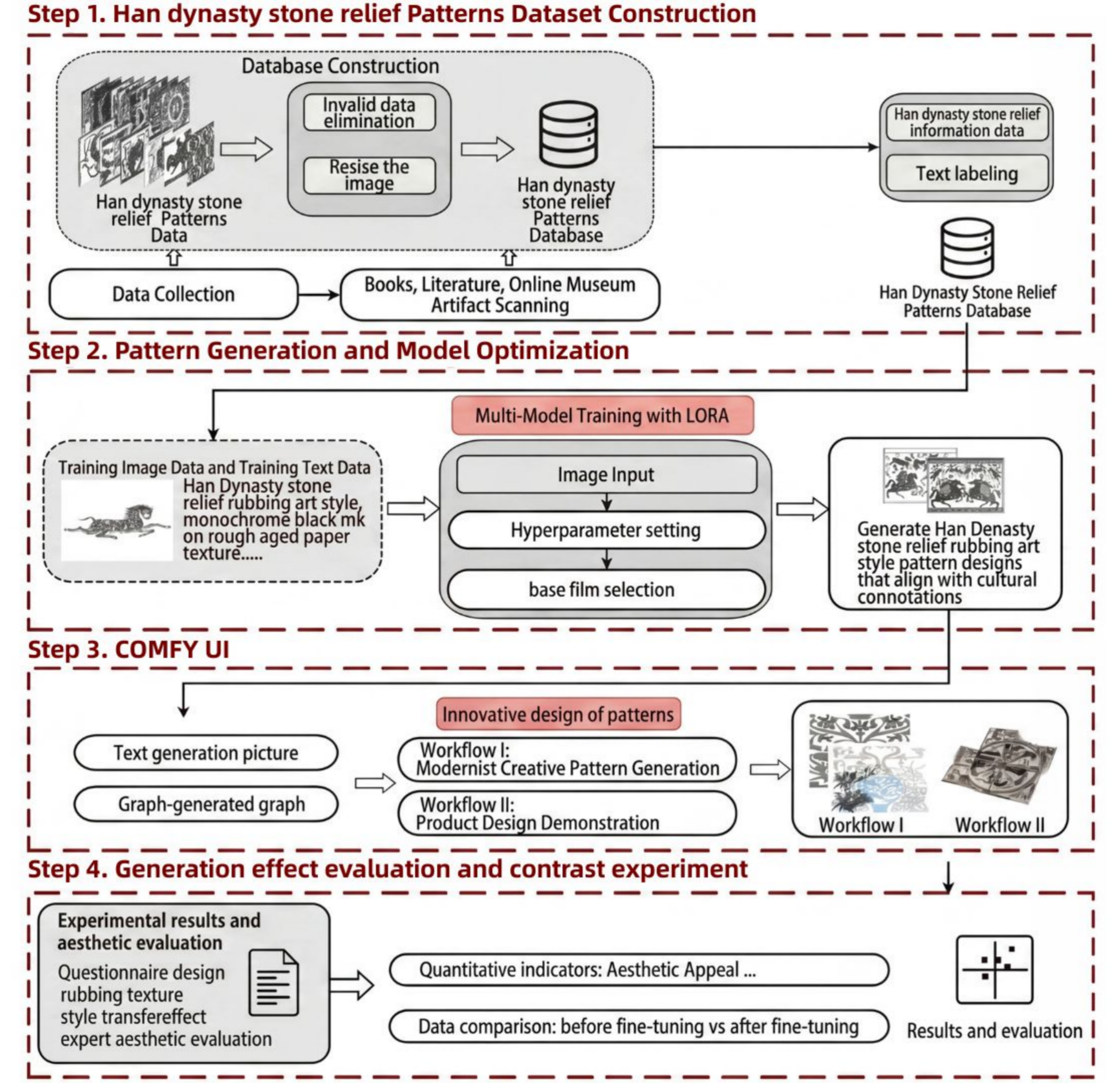
Han Dynasty stone relief rubbings contain a distinctive visual lexicon shaped by silhouette modeling, linear carving, high black-and-white contrast, and epigraphic texture. Existing digital work on this heritage mainly emphasizes archival preservation and visual display, while its transformation into reusable design resources remains insufficient. To address this gap, this study proposes a FLUX.1-dev and LoRA-based generative design framework for Han Dynasty stone relief rubbings. A curated dataset of 196 high-quality rubbing images was constructed from an initial pool of 3,674 images through criteria of authenticity, technical quality, thematic coverage, and annotation feasibility. A dual annotation strategy combining JoyCaption-assisted descriptions with manually revised structural prompts was used to strengthen both stylistic and semantic control. The trained LoRA model was then tested through two workflows: creative pattern generation and cultural product design demonstration. The creative pattern generation workflow outputs a series of stylistically consistent decorative patterns, while the cultural product design demonstration outputs application renderings for products such as scarves and stationery. Comparative evaluation against non-fine-tuned baseline models shows that the proposed model performs better in aesthetic fit, lexicon accuracy, feature restoration, and style consistency. The results suggest that domain-specific LoRA fine-tuning can support the digital revitalization of traditional visual heritage while preserving culturally recognizable features.