Sustainable Fashion in China: Extending the Theory of Planned Behavior to Explore Generation Z’s Premium Payment Behavior under Platform Economy and Guochao Cultural Influences
Keywords:
sustainable fashion; Theory of Planned Behavior; Generation Z; Guochao; greenwashing perception; PLS-SEMAbstract
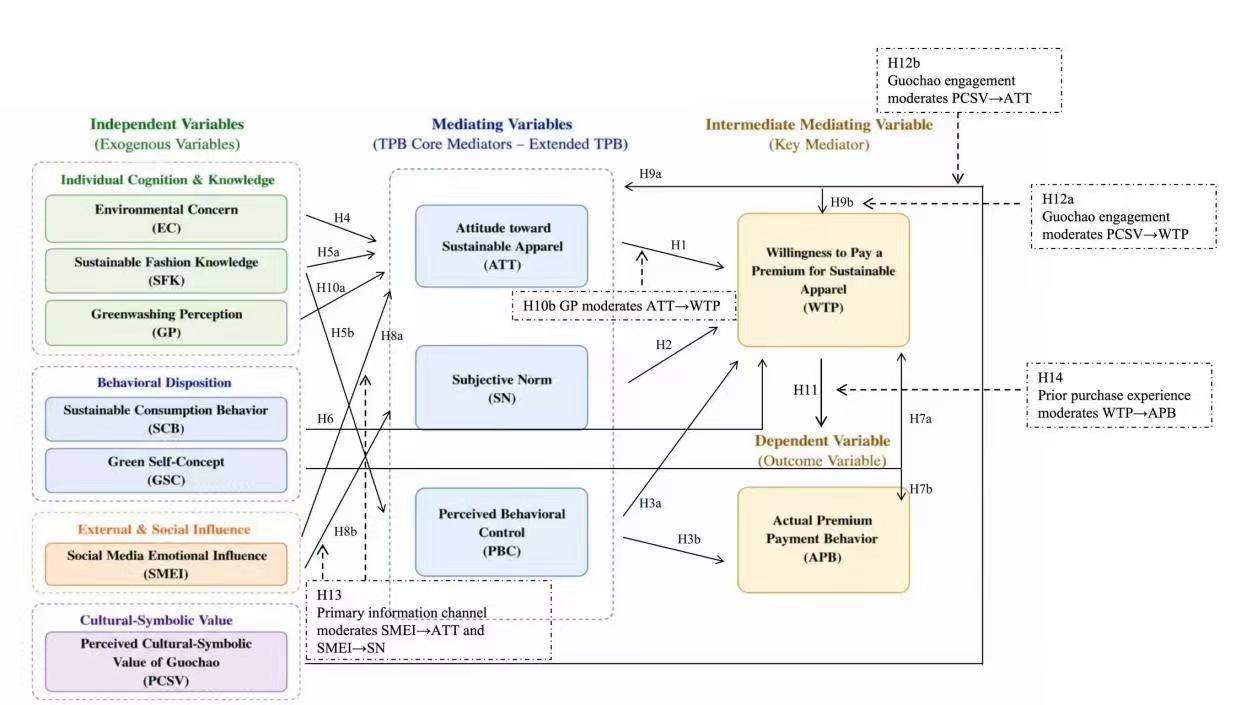
The fashion industry remains one of the most environmentally damaging sectors globally, contributing substantially to carbon emissions, water pollution, and post-consumer textile waste. While Chinese Generation Z consumers demonstrate growing environmental awareness, the gap between pro-environmental attitudes and actual willingness to pay a premium for sustainable apparel remains insufficiently understood, particularly within China’s platform economy and Guochao cultural context. This study extends the Theory of Planned Behavior (TPB) by integrating environmental concern, sustainable fashion knowledge, sustainable consumption behavior tendency, green self-concept, greenwashing perception, social media emotional influence, and perceived cultural-symbolic value of Guochao to explain Chinese Gen Z consumers’ willingness to pay a premium and actual payment behavior. Drawing on 447 survey responses, with 419 valid responses retained after screening, the proposed model is estimated using PLS-SEM implemented in Python, supplemented by permutation-based multi-group analysis. Perceived cultural-symbolic value is the strongest correlate of willingness to pay a premium (coefficient = 0.341), exceeding the core TPB constructs. Notably, attitude does not exhibit an independent direct effect on willingness to pay after identity-based, behavioral-disposition, and cultural-symbolic variables are included, suggesting that generalized favorable attitudes are absorbed by more proximal commitment mechanisms. Greenwashing perception is positively associated with attitude and positively moderates the attitude–willingness-to-pay path, but the interaction effect is weak (effect size = 0.011) and is therefore interpreted cautiously as a boundary condition rather than a strong explanatory mechanism. The study contributes to fashion technology research by offering a localized, platform-aware extension of TPB and by highlighting how cultural-symbolic value, platform-mediated influence, and authenticity verification shape sustainable fashion payment behavior in China’s livestream and social-commerce ecosystem.