Parametric Measurement and Communication Performance of Immersive Experiences in Digital Fashion Shows
Keywords:
digital fashion show, fashion technology, immersive experience, virtual try-on, interactive fashion system, platform conversionAbstract
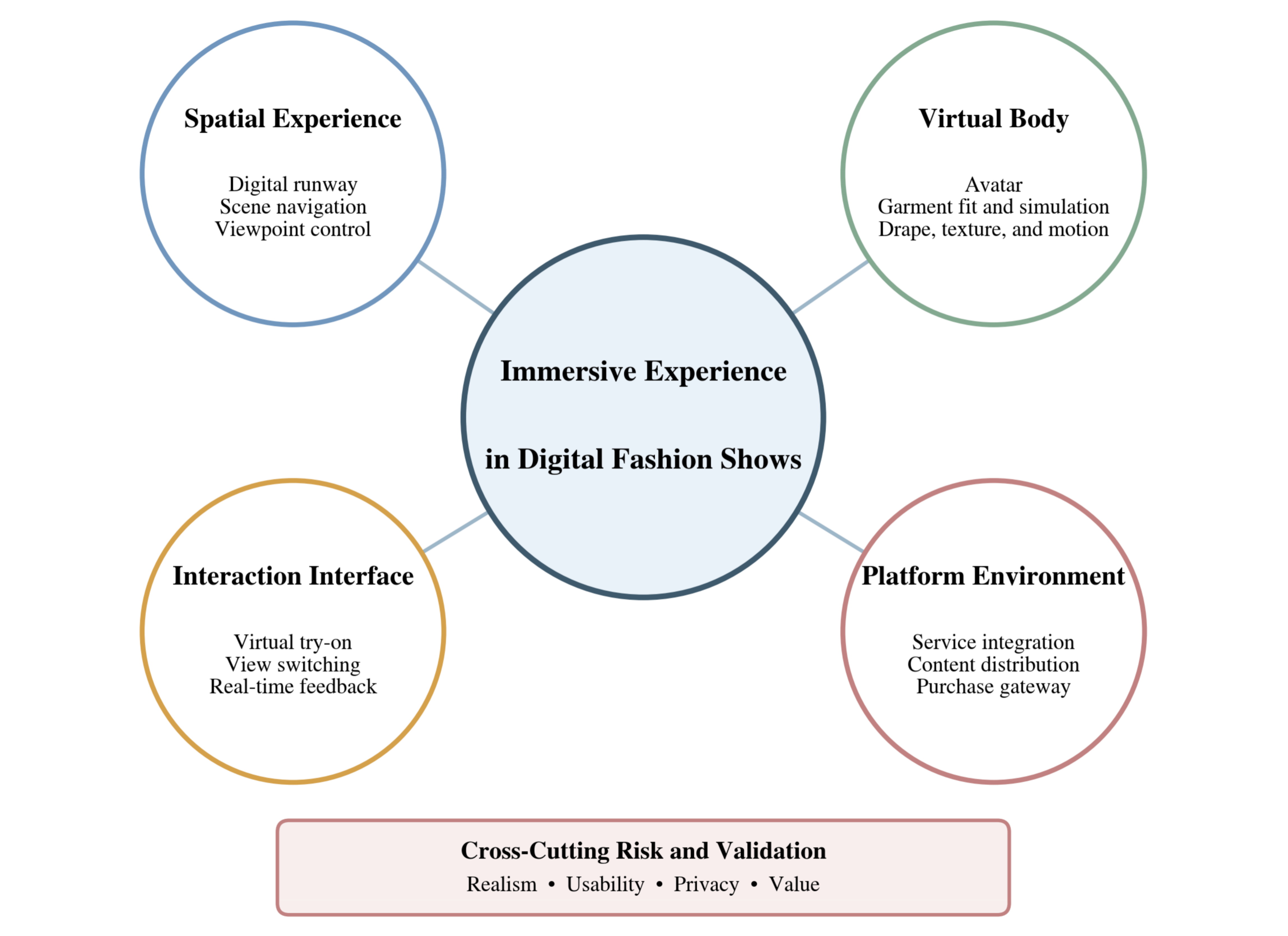
Digital fashion shows are shifting from online broadcasts of physical runways toward media events jointly organized by virtual scenes, digital bodies, interactive interfaces, and platform gateways. This study retains the original two-layer research logic while narrowing statistical claims to the level supported by traceable data. On the design side, 30 case records were coded using a multi-label scheme for spatial immersion, technological spectacle, virtual body, interactive behavior, platform conversion, brand narrative, and risk representation. On the feedback side, 158 public content entries and a three-stage comment dataset from Bilibili, YouTube, Douyin, and Xiaohongshu were examined: 9,313 raw retrieval records were reduced to 4,721 cleaned candidate comments, from which a platform-stratified purposive subset of 204 comments was coded for exploratory interpretation. Among the 30 case records, platform conversion has the highest occurrence rate (50.0%), followed by virtual body (43.3%), technological spectacle (40.0%), interactive behavior (33.3%), brand narrative (30.0%), spatial immersion (23.3%), and risk representation (10.0%). Recurring combinations include virtual body–platform conversion, technological spectacle–virtual body, interactive behavior–platform conversion, and spatial immersion–brand narrative. Within the purposively coded subset, visual and technological novelty was highly visible but did not by itself provide evidence of stronger interaction; interaction-related expressions, platform pathways, and conversion intention were interpreted as more action-oriented signals, while some comments also raised commercial skepticism about platform conversion. Among the comments coded for risk feedback, concerns centered on artificiality, uncanny-valley effects, usability, and value. The exploratory findings suggest that communication performance may be better understood through the coordination of spatial rules, bodily credibility, executable interaction, platform pathways, and risk response than through isolated technological display. From a fashion-technology perspective, the seven-parameter framework can also function as an exploratory design checklist for digital-runway navigation, virtual-garment and avatar fidelity, try-on feedback, platform integration, and risk testing. The findings therefore connect communication evaluation with the design and development of digital fashion systems.