The Impact of Sustainable Innovation Capability on Market Value in Apparel Enterprises: Evidence from China
Keywords:
sustainable innovation capability, market value, apparel enterprisesAbstract
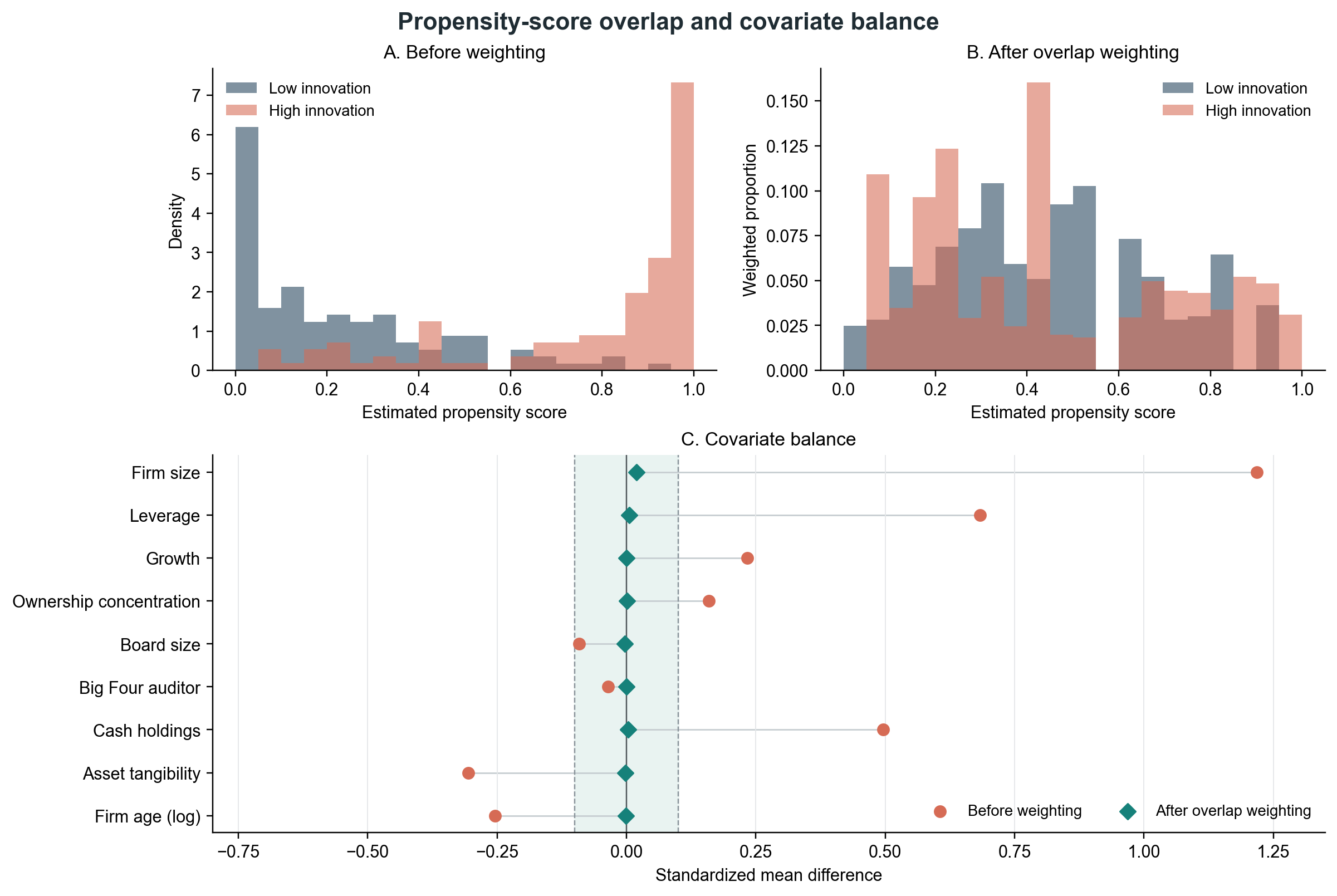
This study examines whether sustained input-side innovation capability is associated with firm market value in China's apparel industry, where firms face increasing sustainability pressure. Using a panel dataset of 225 firm-year observations from 40 A-share listed firms in the textile, apparel, and leather sectors during 2010-2023, we employ regression models with industry-year fixed effects, a financial-performance mechanism analysis, moderation analyses, overlap weighting, and alternative-measure tests. Sustainable innovation capability is operationalized by the natural logarithm of Input Innovation Persistence (IIP), which captures the continuity of innovation input rather than a pure green-patent measure. The results show that Ln(IIP) is positively associated with Tobin's Q in the industry-year fixed-effects specification (beta = 0.151, p < 0.05 under heteroskedasticity-robust inference). The mechanism analysis provides constituent-path evidence consistent with an ROA pathway. Boundary-condition tests indicate that firm size, ESG performance, and digital transformation strengthen the innovation-value association. Robustness analyses based on overlap weighting and alternative measures provide complementary evidence for the positive association, although the observational design warrants a cautious interpretation of causality. This study contributes by offering management a roadmap for strategic resource allocation, investors a refined valuation lens, and regulators a rationale for promoting digital-sustainability synergies in legacy industries.