Review and Visual Analysis of Innovation Design in Traditional Patterns in China from the Perspective of Digital Intelligence
Keywords:
digital intelligence technology; traditional patterns; CiteSpace; VOSviewer; visual analysisAbstract
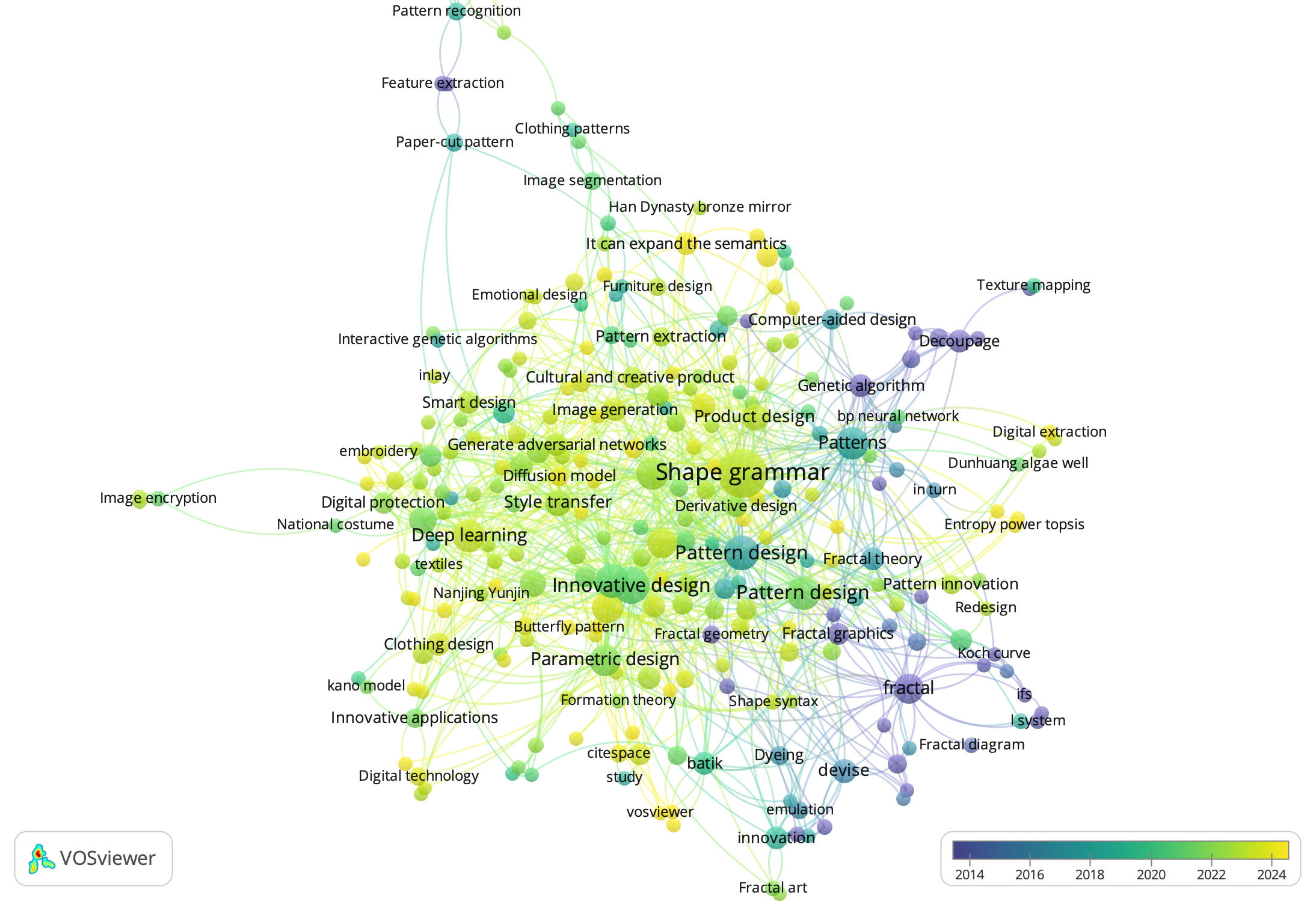
From the perspective of bibliometric visualization, this paper provides a comprehensive overview of the development of innovative design research on traditional Chinese patterns under the lens of digital intelligence over the past two decades. It systematically examines annual publication volume, key authors, research topics, institutions, hotspots, and evolutionary trends. Using bibliometric tools such as CiteSpace and VOSviewer, we analyzed literature from 2003 to 2024 retrieved from the CNKI (China National Knowledge Infrastructure) database to generate visual maps and conduct quantitative analysis. In recent years, technologies such as AIGC (AI-Generated Content), intelligent design, and big data have significantly advanced the innovation of traditional patterns, giving rise to three major research hotspots: pattern generation, the integration of Kansei engineering and shape grammar, and virtual simulation with database construction. Despite the absence of long-term and consistent author groups, small research teams and core contributors have emerged. Research institutions are predominantly universities, with current research hotspots focusing on "artificial intelligence," "innovative design," and "shape grammar." The field is presently concentrated on studies exploring innovative design pathways for specific traditional patterns driven by AIGC and intelligent algorithms. However, a high degree of similarity in design approaches and models remains a limitation. Future research should stay abreast of cutting-edge technologies and, grounded in a deep understanding of traditional patterns and their cultural significance, pursue interdisciplinary collaboration. Researchers are encouraged to evolve from mere users of existing algorithms and platforms to developers, thereby enabling more comprehensive and in-depth studies in AI-assisted traditional pattern innovation.