Lighting Design through Morphological Translation of the Zhuang Embroidered Ball Using the Analytic Hierarchy Process
Keywords:
Zhuang embroidered ball, morphological translation, lighting design, analytic hierarchy process, perceptual evaluationAbstract
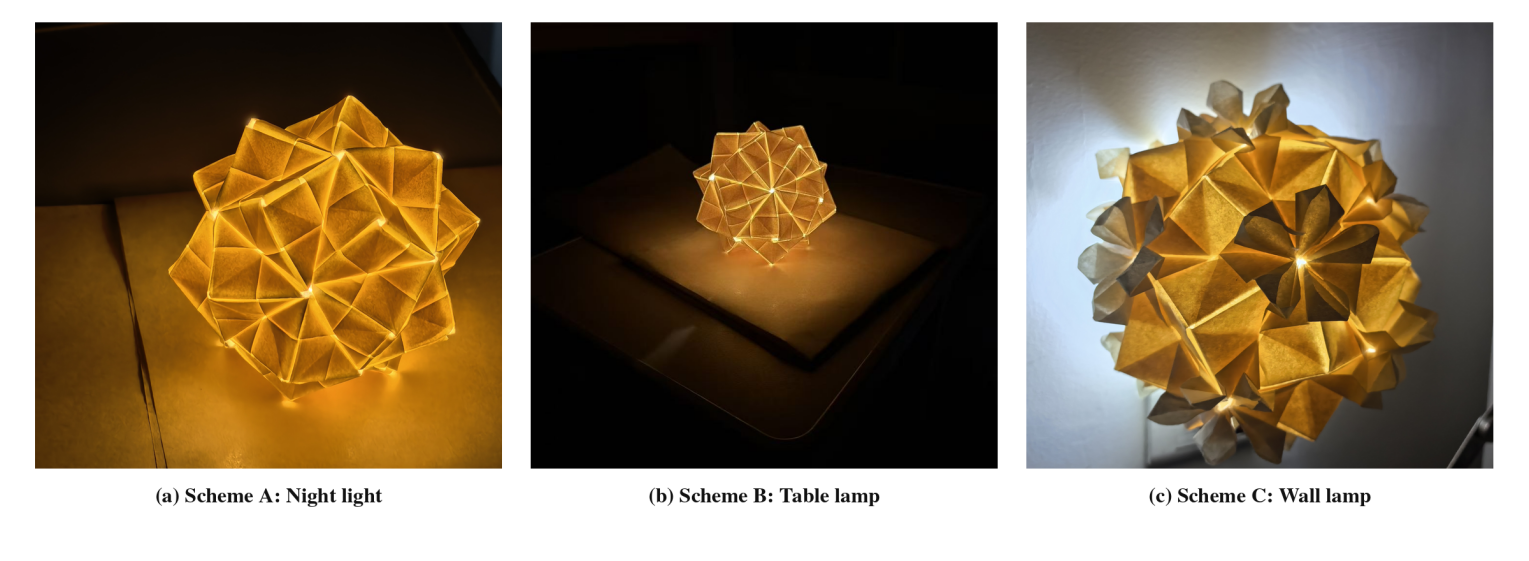
To investigate a structurally grounded approach to translating traditional Zhuang craft symbols into contemporary products, this study uses the Jingxi Zhuang embroidered ball in Guangxi as its primary morphological reference and examines three modular folded-lighting schemes: a night light, a table lamp, and a wall lamp. Literature and project records were used to extract near-spherical enclosure, repeated petal units, central convergence, layered connections, and a multicolored palette. These features were organized into a traceable mapping from source features to abstract relations, design variables, and perceptual criteria. The quantitative evaluation combined the analytic hierarchy process (AHP) with image-based expert ratings. Nine complete evaluation forms were collected through network-based recruitment. A professional-background audit identified seven respondents with directly relevant teaching, research, or professional practice; the other two respondents were not classified as domain experts. The same seven professionally qualified respondents also had individual consistency ratios below 0.10 and therefore constituted the final analytic expert panel. The aggregated matrix had a consistency ratio of 0.0094. The weights for cultural recognizability, formal aesthetics, translation coherence, contextual fit, and perceived lighting ambience were 0.3499, 0.2206, 0.2147, 0.1339, and 0.0810, respectively. Within this expert-based cross-category comparison, Scheme C, the wall lamp, obtained the highest composite score of 69.70, followed by Scheme B at 68.32 and Scheme A at 66.16. Scheme A performed best in contextual fit, Scheme B in formal aesthetics, and Scheme C in cultural recognizability. Ten upward and downward single-weight perturbation scenarios retained the same ranking. Because the panel was small, professionally screened following network-based recruitment, and evaluated the schemes through images, the findings are interpreted as exploratory design-decision evidence rather than independent or population-level validation. The study integrates traceable morphological mapping, professional-background screening, consistency testing, normalized weighting, and sensitivity analysis into a reproducible framework for early-stage design evaluation when direct access to physical prototypes is unavailable.